
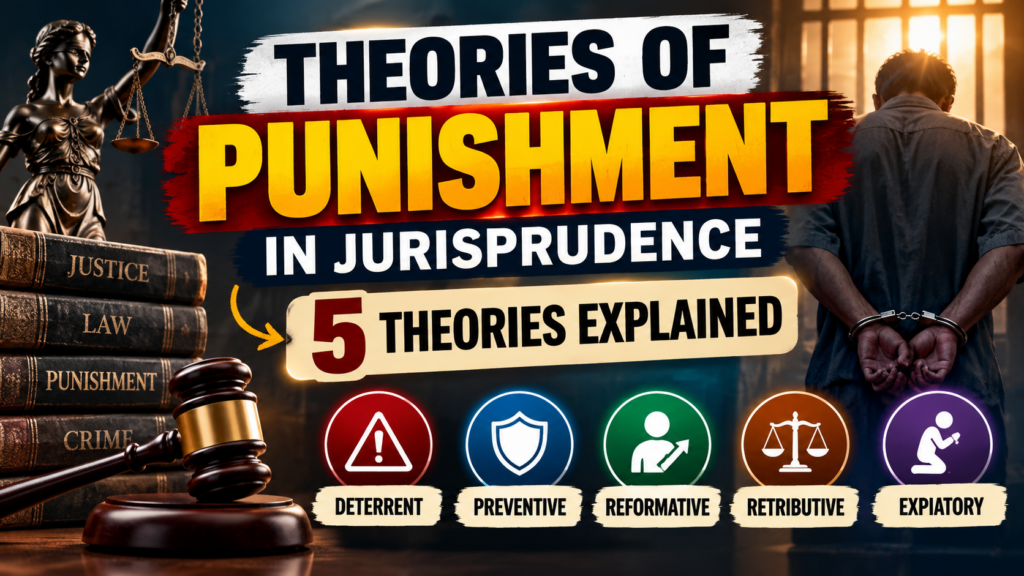
Punishment is imposed on a person who commits an offence. However, the purpose of punishment is not always the same. Sometimes it is intended to create fear in society, sometimes to prevent the offender from committing another crime, and sometimes to reform the offender. These different purposes are explained through various theories of punishment.
Theories of Punishment
- Deterrent Theory — भय पैदा करके अपराध रोकना
- Preventive Theory — अपराधी को अपराध करने से रोकना
- Reformative Theory — अपराधी का सुधार और पुनर्वास
- Retributive Theory — बदला / प्रतिशोध
- Expiatory Theory — प्रायश्चित / पश्चाताप
Easy Way to Remember
D → P → R → R → E
1. Deterrent Theory
Deterrent Theory aims to prevent crime by creating a fear of punishment in the mind of the offender as well as other members of society. The basic idea is that if a person knows that committing a crime will result in serious punishment, he may think twice before committing it. Thus, punishment acts as a warning to others.
For example, strict punishment for serious offences such as murder or rape may discourage other people from committing similar offences. The theory therefore focuses more on preventing future crimes through fear than on reforming the offender.
Criticism: Excessive emphasis on harsh punishment may not always reduce crime. It may also ignore the social, economic and psychological reasons behind criminal behaviour.
2. Preventive Theory
Preventive Theory focuses on preventing the offender from committing another crime by disabling or restricting him. The purpose is not necessarily to create fear, but to make it difficult or impossible for the offender to repeat the offence.
For example, imprisonment prevents an offender from freely committing crimes in society while he is in prison. Similarly, cancellation of a driving licence may prevent a person from repeatedly committing certain driving-related offences.
Criticism: This theory mainly concentrates on controlling the offender. It may fail to consider the reasons behind the criminal behaviour and therefore may not bring about permanent change.
3. Reformative Theory
Reformative Theory considers the offender as a person who can be changed and rehabilitated. Instead of treating punishment merely as revenge, this theory tries to understand why the person committed the offence and attempts to correct his behaviour.
Education, counselling, vocational training and other rehabilitative measures may help an offender become a responsible member of society. This approach is particularly important in the case of juveniles and first-time offenders, where there may be greater scope for reform.
Criticism: A purely reformative approach may not always be suitable for extremely serious or repeated offences. The nature of the crime and the safety of society must also be considered.
4. Retributive Theory
Retributive Theory is based on the idea of deserved punishment. In simple words, a person who commits a wrong should suffer a proportionate consequence for that wrong. It is often associated with the principle of “an eye for an eye”, although modern criminal justice does not support unlimited revenge.
The main purpose is to satisfy the sense of justice by ensuring that the offender is appropriately punished for the harm caused. The punishment should generally be proportionate to the seriousness of the offence.
Criticism: If punishment is understood merely as revenge, it may become harsh and ignore the possibility of reforming the offender.
5. Expiatory Theory
Expiatory Theory is based on the idea of repentance and atonement. According to this theory, an offender may cleanse his guilt through suffering, repentance and acceptance of responsibility for his wrongdoing.
The focus is therefore not simply on punishing the offender but also on allowing him to realise his mistake and make amends for the wrong committed.
Criticism: Mere repentance may not be sufficient in every case, particularly where the offence has caused serious harm to another person or to society.
Conclusion
Each theory of punishment has its own purpose, strengths and weaknesses. The modern approach to criminal justice does not depend entirely on one theory. Depending upon the nature of the offence, circumstances of the offender, possibility of reform and needs of society, different approaches may be required.
For serious or repeated crimes, deterrent and preventive approaches may be important, while in the case of juveniles and first-time offenders, a reformative approach may be more appropriate. Thus, the ideal system of punishment seeks a balance between deterrence, prevention, retribution, reform and social justice.